 Golden Playbox
Prepared by Golden Playbox · Published November 13, 2026
How to play
- Choose three to five cards. Cut them out or leave the sheets whole.
- Take turns answering, listening, or passing. Real and imagined answers are welcome.
- Use the final-page host guide for a gentle opening and a topic-specific extension.
Neighborhoods are made from ordinary details: a useful shop, a familiar corner, a place to pause, and the people who make a space welcoming. These cards invite observation and imagination as well as memory. They work for someone who has lived in one place for years and for someone who would rather invent a neighborhood from scratch.
Inside this conversation pack
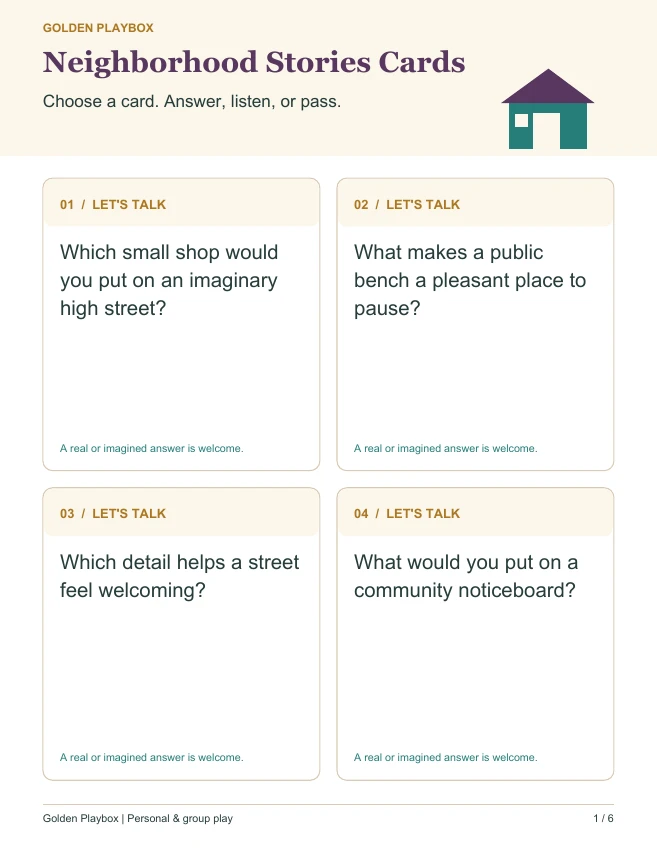
The neighborhood stories cards pack contains twenty original questions, arranged as four large-print cards on each of five pages, followed by a one-page host guide. Both A4 and US Letter versions contain the same cards. You can cut along the card borders, leave each page whole, or read a question aloud. There is no answer key because these are invitations to talk, not facts to get right. A short response, an imagined answer, or a pass is always acceptable.
A comfortable opening
Use the question about a useful shop as a low-pressure opening. People can choose a real shop, a remembered one, or a completely imaginary business. Avoid asking participants to disclose an address or explain why they moved. Follow the group toward public places and small details rather than personal circumstances.
All twenty prompts
- Which small shop would you put on an imaginary high street?
- What makes a public bench a pleasant place to pause?
- Which detail helps a street feel welcoming?
- What would you put on a community noticeboard?
- Would you prefer a leafy square or a lively market corner?
- What name would suit a friendly neighborhood cafe?
- Which sound would belong in a picture of your ideal street?
- What could make a library feel inviting from the outside?
- Which local landmark is easiest to describe without naming it?
- What would you plant in a small shared garden?
- How might neighbors welcome someone new without being intrusive?
- What would make a corner shop window interesting?
- Which ordinary building could tell a good story?
- Where would you place a public clock in an imaginary town?
- What makes a walking route enjoyable to look at?
- What kind of small community event would you enjoy observing?
- How could a street celebrate a season with simple decorations?
- Which detail would you photograph on a neighborhood walk?
- What would you call a little square with three trees?
- Which feature should we add to our imaginary neighborhood last?
Try a different format
Draw a simple imaginary street on a spare sheet and let each participant add one feature. A bench, a tree, a noticeboard, and a cafe can all generate discussion about what makes a place pleasant. The purpose is shared storytelling, not judging anyone’s real neighborhood or designing an official accessibility plan.
Print and play
Choose A4 or US Letter, print at 100%, and keep any answers or calling list with the host. Free for personal and group activities. Printing help and hosting tips.
More games to try
- The 1960s Quiz — Ten multiple-choice questions about familiar music, television and milestones of the 1960s.
- Working Life Cards — Working life includes paid jobs, unpaid responsibilities, informal help, and skills learned along the way.
- Journey Stories Cards — Journeys can be long adventures or a familiar ride across town.