 Golden Playbox
Prepared by Golden Playbox · Published November 13, 2026
How to play
- Print the two question pages for each player or team. Keep the answer key with the host.
- Circle one answer for each question, or read the choices aloud.
- Award one point per correct answer, or play without keeping score.
This printable 1960s quiz brings together television, music, space exploration, a car, a drawing toy, and the Olympic Games. The ten questions have three choices each, so players can recognize an answer even when a name does not come immediately to mind. It is a mixed-topic social quiz rather than a detailed history exam, and it can be played individually, in pairs, or with the host reading aloud.
What the three pages contain
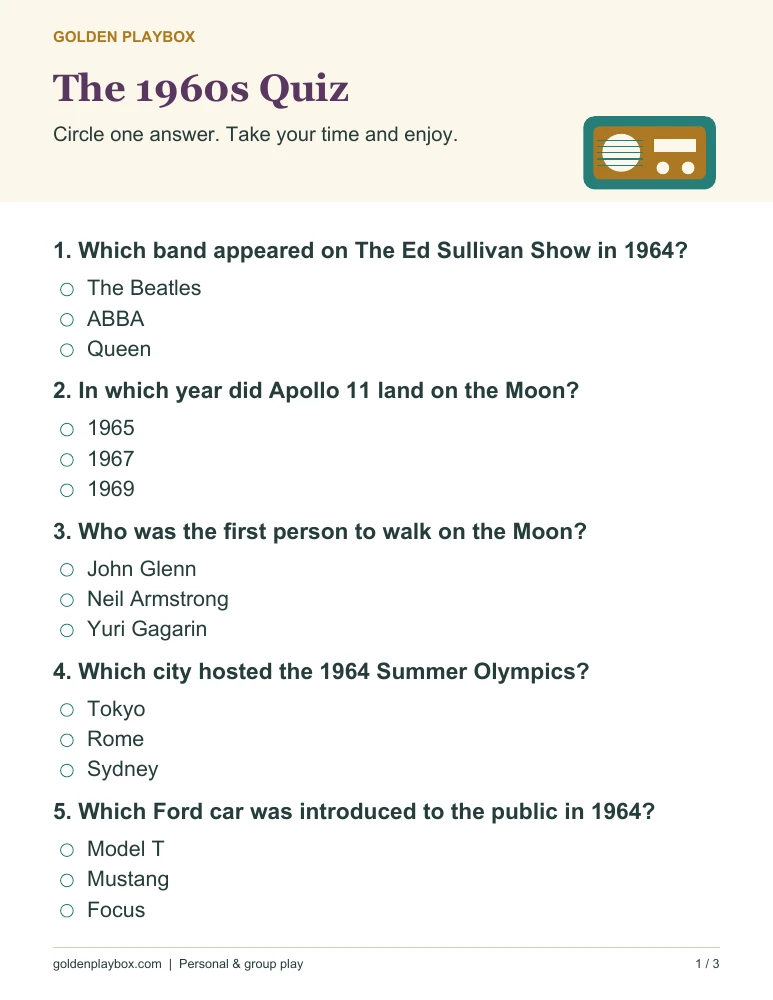
The first two pages hold five questions each. Page three is the answer key and should stay with the host until the round ends. A4 and US Letter downloads contain the same questions in the same order. Print the two question sheets for each player or team, with one answer sheet for the host. A pencil is enough; there are no pictures to identify, recordings to play, or extra materials to prepare.
A varied round, with an American emphasis
The pack includes the Beatles on The Ed Sullivan Show, Apollo 11, the 1964 Tokyo Olympics, the Ford Mustang, Etch A Sketch, Mary Poppins, Star Trek, Sesame Street, and the first human in space. Several prompts concern American television or culture. Tell a mixed-nationality group that beforehand, and invite partners to discuss choices. Someone unfamiliar with one program may be more comfortable with the space or toy questions. The sheet does not assume that participants personally watched these events.
How to host the questions
Read the question and all three choices before accepting an answer. Give people time to consider the options, and repeat them if requested. In a team version, ask each pair to settle on one choice together. Keep the scoring simple: one point per correct answer, for a possible ten. You can also skip points entirely and reveal each answer after a short discussion. A guessed answer is still a perfectly valid part of a multiple-choice game.
Two useful examples for the host
The Apollo 11 question asks for a year and offers 1965, 1967, and 1969. The correct choice is 1969. The following question asks who first walked on the Moon: Neil Armstrong. Keep those ideas separate when explaining the answers. The final question concerns Yuri Gagarin, the first human in space in 1961, rather than a Moon landing. That distinction helps prevent the two milestones from becoming muddled during a lively discussion.
The television questions also ask different things. Julie Andrews is the performer in the 1964 film Mary Poppins; Star Trek is the series that began in the United States in 1966; Sesame Street is the children's program that began in 1969. Accept the printed answer without requiring an extra actor, character, episode, or song title. The additional detail can become optional conversation after everyone has answered.
Make the reveal part of the enjoyment
After checking the choices, ask which item someone would put in a small exhibition about the decade. A drawing toy, a car photograph, a television listing, or a model spacecraft can lead to very different explanations. Another gentle follow-up is to choose the question that was most interesting, rather than the one a person got wrong. Avoid asking anyone to prove a recollection or supply an exact date from their own life.
Answers and source notes
The answer sequence is The Beatles, 1969, Neil Armstrong, Tokyo, Mustang, Etch A Sketch, Julie Andrews, Star Trek, Sesame Street, and Yuri Gagarin. The source links supplied with this page point to NASA, the relevant official entertainment or manufacturer sites, and the Japanese Olympic Committee. They support the factual answers; the questions and layout are written for this pack. Suggested playing time is approximate, so a conversation-led round may naturally last longer.
Print and play
Choose A4 or US Letter, print at 100%, and keep any answers or calling list with the host. Free for personal and group activities. Printing help and hosting tips.
References for this game
More games to try
- Working Life Cards — Working life includes paid jobs, unpaid responsibilities, informal help, and skills learned along the way.
- Neighborhood Stories Cards — Neighborhoods are made from ordinary details: a useful shop, a familiar corner, a place to pause, and the people who make a space welcoming.
- Journey Stories Cards — Journeys can be long adventures or a familiar ride across town.