 Golden Playbox
Prepared by Golden Playbox · Published November 13, 2026
How to play
- Print pages 1-3 for each player or pair. Keep pages 4-6 with the host.
- Circle one answer for each question. Read the choices aloud if helpful.
- Award one point per correct answer out of twelve, or play without scores.
About this printable round
The smell of bread may be familiar, but this printable game needs only paper and pencils. Twelve questions explore common baking terms, ingredients and recognizable loaves. The round is designed for people with different levels of kitchen experience: some answers come from shopping or eating rather than making bread. Three choices accompany each question, and the separate key explains the relevant distinction without turning the activity into a technical baking lesson.
Host the conversation
A loaf picture can provide an optional starting point. Ask which shapes people recognize, and allow regional names before beginning the scored questions. When discussing yeast, keep the explanation about fermentation rather than making a health claim. For a creative follow-up, design an imaginary bakery window with three breads and a handwritten sign. Nobody has to provide a family recipe or demonstrate a technique. If the group wants to bake afterward, use a complete tested recipe with suitable food-handling guidance; the quiz defines words and ingredients but is not an instruction sheet for producing a safe meal.
Questions, answers and talking points
The following walkthrough contains spoilers. Keep this section with the host if participants want to answer the printable questions first.
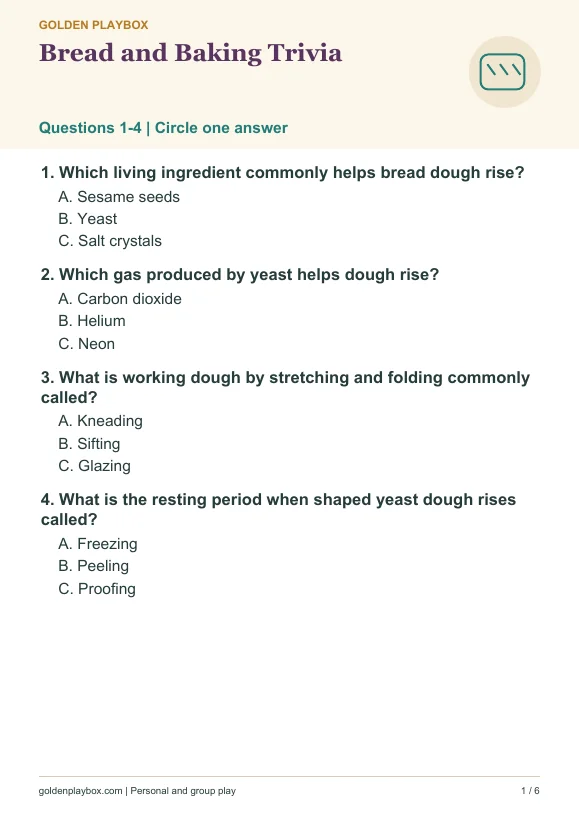
Which living ingredient commonly helps bread dough rise? Yeast. Yeast produces carbon dioxide during fermentation, helping dough expand. The gas needs a structure to hold it, which connects this answer with the gluten question.
Which gas produced by yeast helps dough rise? Carbon dioxide. Carbon dioxide forms bubbles in the dough. Bread is not inflated with bottled gas; fermentation produces the gas within the mixture under suitable conditions.
What is working dough by stretching and folding commonly called? Kneading. Kneading develops dough structure and distributes ingredients. Different breads use different methods, so the quiz defines the action without prescribing one universal technique.
What is the resting period when shaped yeast dough rises called? Proofing. Proofing allows shaped dough to expand before baking. Terminology can vary, but the central idea is a controlled rise rather than the final oven stage.
Which protein network gives wheat dough much of its elasticity? Gluten. Gluten forms a network when wheat flour is hydrated and worked. Other grains and gluten-free mixtures behave differently, which is why the question specifies wheat.
Which bread is traditionally a long, narrow French loaf? Baguette. A baguette is a long, narrow loaf associated with France. This shape clue provides a familiar contrast to round or ring-shaped baked products.
Which bread is shaped like a ring and commonly boiled before baking? Bagel. Bagels are traditionally boiled before baking. That preparation contributes to their distinctive crust and texture, making the answer more than a shape-matching exercise.
Which flatbread is well known for forming a pocket? Pita. Pita can form a pocket as steam separates layers during baking. Not every piece opens perfectly, so the question describes the familiar style rather than a guarantee.
Which enriched French bread often contains eggs and butter? Brioche. Brioche is an enriched bread containing ingredients such as eggs and butter. Enrichment distinguishes it from simpler flour-water-yeast-salt doughs without making a nutritional judgment.
What is dusting flour through a fine mesh called? Sifting. Sifting passes flour or another powder through a mesh. It breaks up lumps and separates particles, unlike scoring, which cuts the surface of a loaf.
What are shallow cuts made on a loaf before baking called? Scoring. Scoring creates intentional cuts in the dough surface. These can guide expansion and create patterns, linking a practical baking action with an attractive finished appearance.
Which grain is traditionally used to make pumpernickel bread? Rye. Traditional German pumpernickel is made with rye. Some breads sold under the same name elsewhere use different flour blends, so the traditional wording matters.
Print and play
Choose A4 or US Letter, print at 100%, and keep any answers or calling list with the host. Free for personal and group activities. Printing help and hosting tips.
References for this game
More games to try
- The 1960s Quiz — Ten multiple-choice questions about familiar music, television and milestones of the 1960s.
- Working Life Cards — Working life includes paid jobs, unpaid responsibilities, informal help, and skills learned along the way.
- Neighborhood Stories Cards — Neighborhoods are made from ordinary details: a useful shop, a familiar corner, a place to pause, and the people who make a space welcoming.