 Golden Playbox
Prepared by Golden Playbox · Published November 13, 2026
How to play
- Print pages 1-3 for each player or pair. Keep pages 4-6 with the host.
- Circle one answer for each question. Read the choices aloud if helpful.
- Award one point per correct answer out of twelve, or play without scores.
About this printable round
Recognizable titles lead this composer quiz, so no one needs to read music or identify an audio excerpt. Twelve questions connect well-known works with their composers. The choices offer a route into the answers for occasional listeners as well as concert enthusiasts. This is a paper-based activity with a separate key, suitable for a music-themed afternoon where conversation matters as much as the final tally. The notes distinguish works that are often heard outside the concert hall.
Host the conversation
Read the work titles slowly and allow people to recognize them before reading the choices. If a participant knows a tune but not its composer, welcome that contribution without asking for a performance. Optional listening can follow the printed round using recordings you are permitted to play. Choose short excerpts and keep the volume comfortable. For a follow-up, ask which title sounds like a season, a character or a place, then imagine a concert program from those groups. Avoid treating familiarity with European classical music as a measure of anyone's wider musical knowledge.
Questions, answers and talking points
The following walkthrough contains spoilers. Keep this section with the host if participants want to answer the printable questions first.
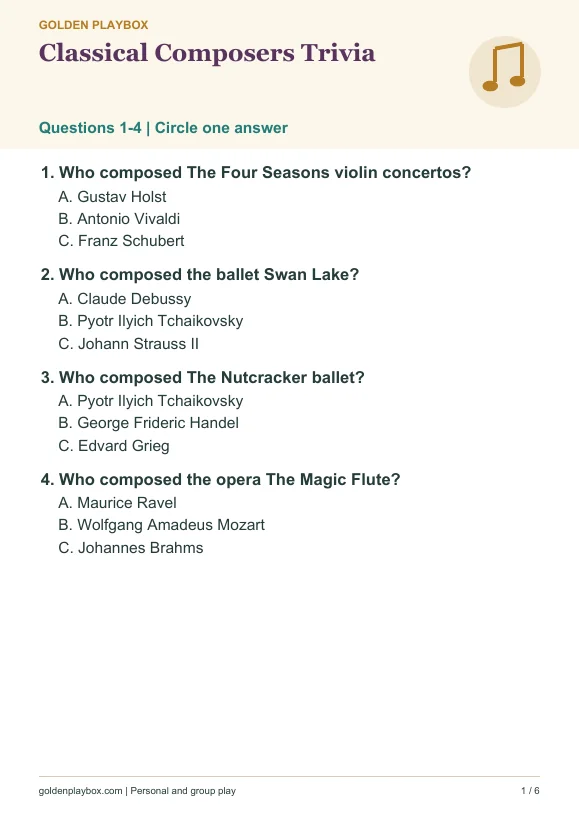
Who composed The Four Seasons violin concertos? Antonio Vivaldi. Vivaldi's Four Seasons consists of four violin concertos. The seasonal titles offer a recognizable link between music and changing weather without requiring an audio example.
Who composed the ballet Swan Lake? Pyotr Ilyich Tchaikovsky. Tchaikovsky composed Swan Lake. Ballet combines music and movement, so some participants may recognize the story or stage images before remembering the composer's name.
Who composed The Nutcracker ballet? Pyotr Ilyich Tchaikovsky. The Nutcracker is another Tchaikovsky ballet. It is distinct from Swan Lake despite sharing a composer, and many of its individual dances are widely familiar.
Who composed the opera The Magic Flute? Wolfgang Amadeus Mozart. Mozart composed The Magic Flute. The title names a stage work rather than a piece solely for solo flute, which makes a useful explanatory detail.
Who composed the Fifth Symphony with its famous four-note opening? Ludwig van Beethoven. Beethoven's Fifth Symphony is recognized for its opening motif. The question specifies the famous opening because many composers wrote a symphony numbered five.
Who composed the orchestral suite The Planets? Gustav Holst. Holst composed The Planets. Its movements draw on astrological character associations, so it is not simply a musical list of all planets recognized today.
Who composed the Blue Danube waltz? Johann Strauss II. Johann Strauss II composed the Blue Danube waltz. The numeral matters because several members of the Strauss family were musicians and composers.
Who composed the oratorio Messiah? George Frideric Handel. Handel composed Messiah. An oratorio is generally presented as a concert work rather than staged like an opera, a useful distinction for the discussion.
Who composed the piano piece Clair de lune? Claude Debussy. Debussy's Clair de lune is a familiar piano piece. Its French title means moonlight, giving the group a gentle image to connect with the answer.
Who composed Bolero? Maurice Ravel. Ravel composed Bolero, known for its repeated rhythmic pattern and gradual orchestral build. Recognition may come from dance or film rather than a concert program.
Who composed the Peer Gynt music including Morning Mood? Edvard Grieg. Grieg wrote incidental music for Peer Gynt. Morning Mood is frequently heard separately, illustrating how an excerpt can become more familiar than its original context.
Who composed The Carnival of the Animals? Camille Saint-Saens. Saint-Saens composed The Carnival of the Animals. Its animal-themed movements offer an accessible bridge from a composer-name quiz to imaginative discussion about musical character.
Print and play
Choose A4 or US Letter, print at 100%, and keep any answers or calling list with the host. Free for personal and group activities. Printing help and hosting tips.
References for this game
More games to try
- The 1960s Quiz — Ten multiple-choice questions about familiar music, television and milestones of the 1960s.
- Working Life Cards — Working life includes paid jobs, unpaid responsibilities, informal help, and skills learned along the way.
- Neighborhood Stories Cards — Neighborhoods are made from ordinary details: a useful shop, a familiar corner, a place to pause, and the people who make a space welcoming.