 Golden Playbox
Prepared by Golden Playbox · Published November 13, 2026
How to play
- Print pages 1-3 for each player or pair. Keep pages 4-6 with the host.
- Circle one answer for each question. Read the choices aloud if helpful.
- Award one point per correct answer out of twelve, or play without scores.
About this printable round
Flowers provide a colorful subject even when the game is printed in black and white. This twelve-question garden quiz uses familiar names, plant parts and growing terms. It avoids asking participants to identify subtle differences between cultivars or remember Latin names. The three choices make it suitable for mixed groups in which some people garden regularly and others simply enjoy flowers. The answer notes explain the botanical vocabulary in ordinary language, offering a little more than a list of correct letters.
Host the conversation
Begin by asking which flower someone would put in a small vase, without assuming everyone has an outdoor garden. Houseplants, public parks and flowers seen in pictures are equally useful starting points. When discussing pollination, separate a flower's appeal to people from its role in reproduction. A second activity can sort the answer words into plant parts, flower names and growing terms. If the group prefers a creative finish, plan a border using contrasting shapes rather than trying to remember precise planting advice. Conditions vary by location, so consult local guidance for actual cultivation.
Questions, answers and talking points
The following walkthrough contains spoilers. Keep this section with the host if participants want to answer the printable questions first.
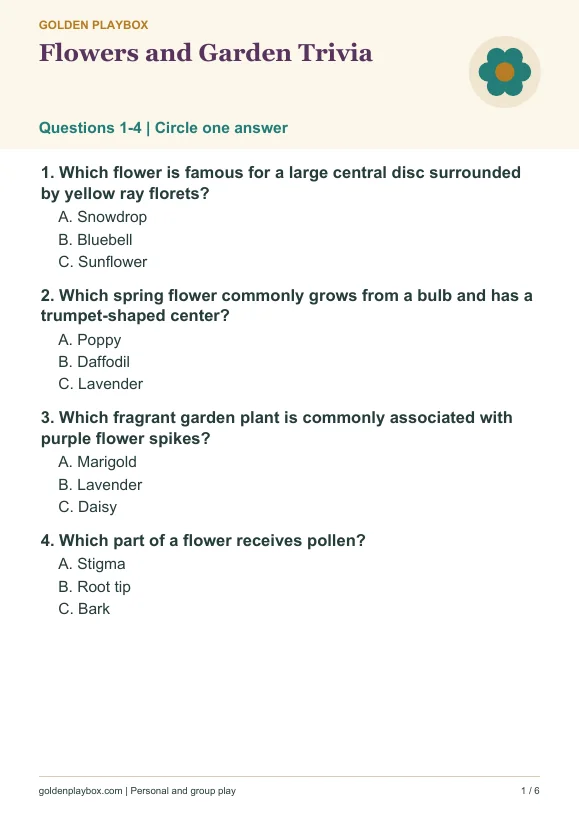
Which flower is famous for a large central disc surrounded by yellow ray florets? Sunflower. A sunflower head contains many small flowers. The large familiar shape is a flower head rather than one simple flower with a single central seed.
Which spring flower commonly grows from a bulb and has a trumpet-shaped center? Daffodil. Daffodils grow from bulbs and have a distinctive central corona. Calling it a trumpet offers a useful everyday description without requiring technical botanical vocabulary.
Which fragrant garden plant is commonly associated with purple flower spikes? Lavender. Lavender commonly has aromatic foliage and purple flower spikes. Flower color can vary by variety, so the wording describes the familiar form rather than every plant.
Which part of a flower receives pollen? Stigma. The stigma is the pollen-receiving part of the flower. This introduces reproductive structure while keeping the answer distinct from unrelated roots and woody tissue.
What is the transfer of pollen called? Pollination. Pollination is the transfer of pollen. It is not the same as germination, which refers to a seed beginning to grow under suitable conditions.
What is a plant that completes its life cycle in one growing season called? Annual. An annual completes its life cycle in one growing season. Garden labels describe growth patterns, not how often a gardener should water a plant.
What is a plant that lives for more than two years called? Perennial. A perennial lives for more than two years. Some die back above ground seasonally, so a bare winter patch does not always mean the plant has died.
Which flower is widely used as a symbol of remembrance? Poppy. The red poppy is widely used as a remembrance symbol. Keep this cultural association separate from assumptions about every participant's personal experience or beliefs.
Which climbing garden plant often has fragrant flowers and prickly stems? Climbing rose. Climbing roses can be trained against supports. Their long stems need appropriate support rather than behaving exactly like plants that cling by tendrils.
Which part of a plant usually develops after a seed germinates below ground? Root. A root normally emerges early in germination and establishes access to water. The visible shoot is only one part of a young plant's development.
What is removing spent flower heads commonly called? Deadheading. Deadheading means removing faded blooms. Its effects vary among plants, so the quiz defines the task without promising that every species will flower again.
What is a layer placed over soil to conserve moisture or suppress weeds called? Mulch. Mulch covers the soil surface. Materials and application methods vary, making the word a description of a gardening practice rather than one particular product.
Print and play
Choose A4 or US Letter, print at 100%, and keep any answers or calling list with the host. Free for personal and group activities. Printing help and hosting tips.
References for this game
More games to try
- The 1960s Quiz — Ten multiple-choice questions about familiar music, television and milestones of the 1960s.
- Working Life Cards — Working life includes paid jobs, unpaid responsibilities, informal help, and skills learned along the way.
- Neighborhood Stories Cards — Neighborhoods are made from ordinary details: a useful shop, a familiar corner, a place to pause, and the people who make a space welcoming.