 Golden Playbox
Prepared by Golden Playbox · Published November 13, 2026
How to play
- Choose three to five cards. Cut them out or leave the sheets whole.
- Take turns answering, listening, or passing. Real and imagined answers are welcome.
- Use the final-page host guide for a gentle opening and a topic-specific extension.
A pastime can be active, quiet, creative, observational, social, or solitary. This deck recognizes that enjoyment does not need an impressive finished result. The questions invite people to choose, imagine, and explain what makes an activity appealing, even if they have never tried it or no longer do it.
Inside this conversation pack
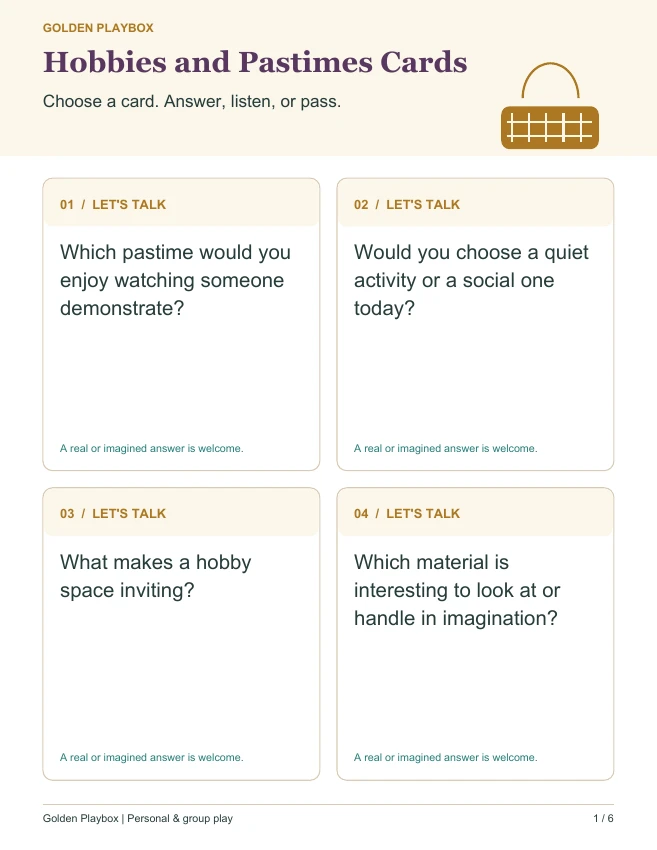
The hobbies and pastimes cards pack contains twenty original questions, arranged as four large-print cards on each of five pages, followed by a one-page host guide. Both A4 and US Letter versions contain the same cards. You can cut along the card borders, leave each page whole, or read a question aloud. There is no answer key because these are invitations to talk, not facts to get right. A short response, an imagined answer, or a pass is always acceptable.
A comfortable opening
Start with choosing a pastime to watch rather than perform. Watching a skilled person paint, repair, cook, or arrange something can be enjoyable in its own right. Make clear that participants are not expected to show a project, explain why they stopped a hobby, or promise to begin a new one.
All twenty prompts
- Which pastime would you enjoy watching someone demonstrate?
- Would you choose a quiet activity or a social one today?
- What makes a hobby space inviting?
- Which material is interesting to look at or handle in imagination?
- Would you rather collect objects, make something, or observe?
- What would you ask a patient beginner-friendly instructor?
- Which hobby tool has an interesting design?
- What could make a short activity satisfying without finishing anything?
- Would you choose a puzzle, a sketch, or a story for a free hour?
- What title would suit an exhibition of everyday hobbies?
- Which pastime could be enjoyed through a window?
- What makes sharing an interest with someone pleasant?
- Would you rather follow a pattern or experiment?
- Which activity might suit a rainy afternoon indoors?
- What could be displayed on a small hobby shelf?
- How can a beginner feel welcome in an established group?
- What would you include in a pretend demonstration table?
- Which hobby sounds interesting even if you never plan to try it?
- What makes leisure feel different from a task?
- Which corner of our imaginary hobby afternoon would you visit first?
Try a different format
Create a fictional hobby afternoon with three corners: something to watch, something to discuss, and something optional to try. A pair can design a display of tools or materials for one activity. The aim is to notice interests without turning leisure into a goal, obligation, or measure of productivity.
Print and play
Choose A4 or US Letter, print at 100%, and keep any answers or calling list with the host. Free for personal and group activities. Printing help and hosting tips.
More games to try
- The 1960s Quiz — Ten multiple-choice questions about familiar music, television and milestones of the 1960s.
- Working Life Cards — Working life includes paid jobs, unpaid responsibilities, informal help, and skills learned along the way.
- Neighborhood Stories Cards — Neighborhoods are made from ordinary details: a useful shop, a familiar corner, a place to pause, and the people who make a space welcoming.