 Golden Playbox
Prepared by Golden Playbox · Published November 13, 2026
How to play
- Print pages 1-3 for each player or pair. Keep pages 4-6 with the host.
- Circle one answer for each question. Read the choices aloud if helpful.
- Award one point per correct answer out of twelve, or play without scores.
About this printable round
The Moon is familiar enough to spot through a window, yet its changing appearance leaves plenty to discuss. This twelve-question printable concentrates on phases, surface features and the Moon's relationship with Earth. There are no calculations and no requirement to identify a photograph. The multiple-choice format makes a comfortable read-aloud activity, while the separate answer guide helps a host explain the difference between what the Moon looks like and what is physically happening.
Host the conversation
A plain ball and a lamp can help demonstrate illumination after the questions, but the paper game needs no props. Keep the room lighting comfortable and never suggest looking directly at the Sun. Ask whether participants have noticed the Moon during daylight; this is a useful way to challenge the assumption that it belongs only to nighttime. If the group enjoys the topic, finish by sketching a crescent and a full circle and asking which appearance people find more striking. Treat personal preferences as conversation, not scored knowledge.
Questions, answers and talking points
The following walkthrough contains spoilers. Keep this section with the host if participants want to answer the printable questions first.
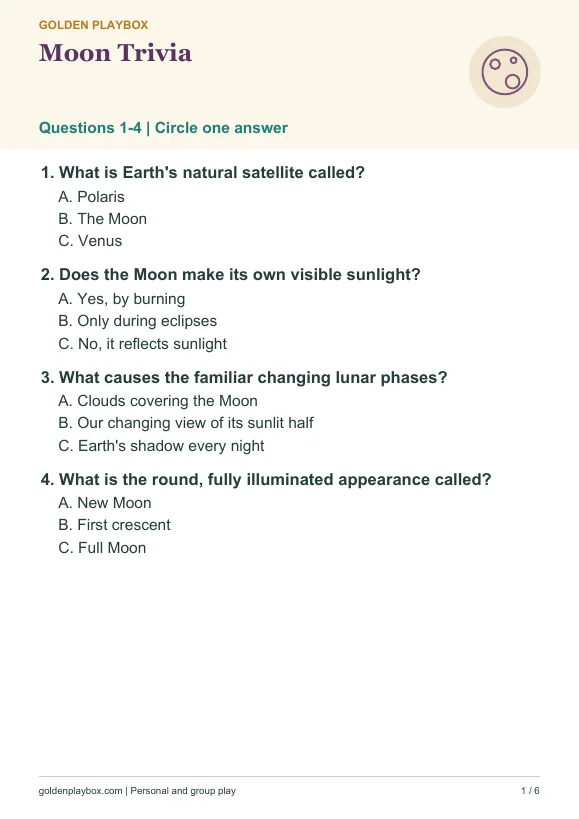
What is Earth's natural satellite called? The Moon. The Moon is Earth's natural satellite. A satellite is an object orbiting another body; the word does not refer only to human-made equipment.
Does the Moon make its own visible sunlight? No, it reflects sunlight. Moonlight is reflected sunlight. This distinction explains why the Moon can appear bright without being a star or producing light by nuclear fusion.
What causes the familiar changing lunar phases? Our changing view of its sunlit half. Phases follow the changing geometry of Sun, Earth and Moon. Earth's shadow is involved in a lunar eclipse, a different and less frequent event.
What is the round, fully illuminated appearance called? Full Moon. At full Moon, the side facing Earth appears fully lit. The Moon has not changed shape; our view of its illuminated portion has changed.
What is the phase called when the Moon is near the Sun in our sky? New Moon. At new Moon, the illuminated half faces mostly away from Earth. The Moon is still present even though it is generally difficult to see.
What created most of the Moon's circular craters? Impacts from space objects. Many lunar craters were produced by impacts. Without Earth's active weather and widespread surface renewal, ancient marks can remain visible for very long periods.
Does the Moon have oceans of liquid water on its surface? No. The dark areas historically called seas are not liquid oceans. Their names preserve an older visual interpretation rather than describing present-day open water.
Compared with Earth's gravity, lunar surface gravity is what? Much weaker. Lunar surface gravity is about one-sixth of Earth's. An astronaut's mass stays the same, while the gravitational force felt as weight changes.
Why do we usually see the same lunar side from Earth? Its rotation and orbit are synchronized. The Moon rotates once in roughly the time it takes to orbit Earth. Saying that it does not rotate would give the wrong explanation.
Can the Moon sometimes be seen during daylight? Yes. The Moon can be visible in daytime when its position and brightness allow it. Night is not a requirement for seeing this familiar object.
Which event occurs when Earth casts a shadow on the Moon? A lunar eclipse. A lunar eclipse places Earth between the Sun and Moon. A solar eclipse involves the Moon blocking our view of the Sun instead.
Which body's gravity is the main cause of Earth's ocean tides? The Moon. The Moon is the main tidal influence, with the Sun also contributing. Local coastlines and ocean conditions help determine the tides people actually observe.
Print and play
Choose A4 or US Letter, print at 100%, and keep any answers or calling list with the host. Free for personal and group activities. Printing help and hosting tips.
References for this game
More games to try
- The 1960s Quiz — Ten multiple-choice questions about familiar music, television and milestones of the 1960s.
- Working Life Cards — Working life includes paid jobs, unpaid responsibilities, informal help, and skills learned along the way.
- Neighborhood Stories Cards — Neighborhoods are made from ordinary details: a useful shop, a familiar corner, a place to pause, and the people who make a space welcoming.