 Golden Playbox
Prepared by Golden Playbox · Published November 13, 2026
How to play
- Print pages 1-3 for each player or pair. Keep pages 4-6 with the host.
- Circle one answer for each question. Read the choices aloud if helpful.
- Award one point per correct answer out of twelve, or play without scores.
About this printable round
A musical afternoon does not require singing or reading notation. This printable quiz explores twelve familiar instruments and the ways they make sound. The questions use recognizable features, such as strings, keys and a sliding tube, so people can reason from the choices. It works as a seated group game with a host reading aloud or as an individual puzzle. The answer guide gives short explanations that can prompt a discussion about concerts, school music or instruments seen on television.
Host the conversation
Keep any optional music clips separate from the paper round, and use a comfortable volume. No participant should need hearing a particular pitch to answer these printed questions. Ask which instrument someone would like to see demonstrated rather than asking them to perform. After revealing answers, sort the instruments by how sound begins: a vibrating string, a vibrating air column or a struck surface. Notice that classification can depend on context; the piano has strings but makes them sound with hammers. That nuance is more interesting than insisting every instrument fits one simple everyday label.
Questions, answers and talking points
The following walkthrough contains spoilers. Keep this section with the host if participants want to answer the printable questions first.
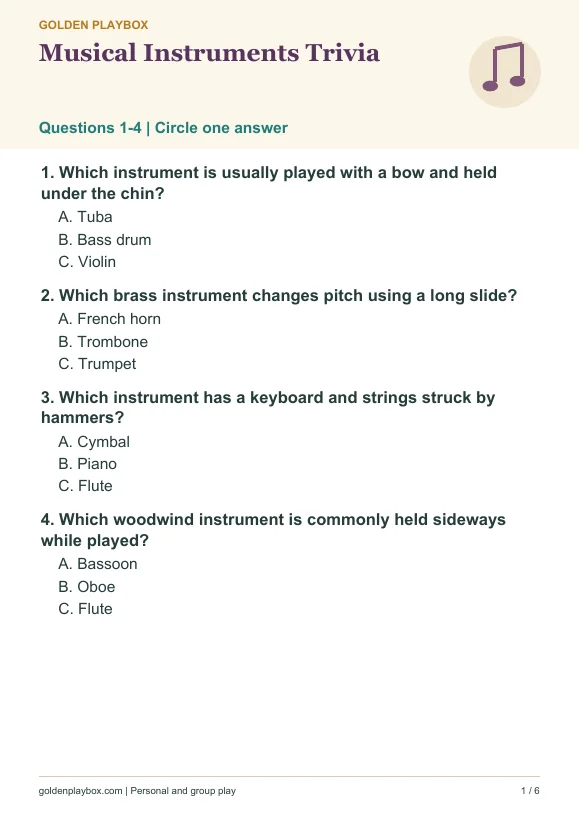
Which instrument is usually played with a bow and held under the chin? Violin. A violin is commonly held between shoulder and chin and played with a bow. It can also be plucked, so bowing is not its only technique.
Which brass instrument changes pitch using a long slide? Trombone. A trombone's slide changes the effective tube length. This visible feature makes it a useful instrument to recognize even without hearing a musical example.
Which instrument has a keyboard and strings struck by hammers? Piano. The piano uses hammers to strike strings when keys are pressed. Its mechanism explains why it can be discussed as both a keyboard and a stringed instrument.
Which woodwind instrument is commonly held sideways while played? Flute. A modern orchestral flute is held sideways. Despite being commonly made of metal, it belongs to the woodwind family through its musical classification and history.
Which instrument uses a single reed and is common in orchestras and jazz? Clarinet. A clarinet uses a single reed attached to its mouthpiece. This contrasts with double-reed instruments and with flutes, which do not use a reed.
Which large string instrument is usually played seated between the knees? Cello. The cello rests on an endpin and is commonly played seated. Its size and lower range distinguish it from the violin without requiring musical notation.
Which instrument has strings stretched across a triangular frame? Harp. A harp's strings are arranged within a frame and are plucked. The recognizable shape makes this a visual knowledge question rather than a listening test.
Which percussion instruments are also called kettledrums? Timpani. Timpani are pitched kettledrums used in orchestras. Unlike many unpitched percussion instruments, their pitch can be adjusted to suit the music being played.
Which small flute sounds higher than the standard orchestral flute? Piccolo. The piccolo is smaller and sounds higher than the standard flute. Instrument size often relates to range, although the quiz does not treat that as a universal rule.
Which low woodwind instrument has a long folded tube and a double reed? Bassoon. The bassoon is a double-reed woodwind with a distinctive folded bore. Its construction permits a long air column without requiring an equally long straight instrument.
Which instrument commonly has six strings and is strummed or plucked? Guitar. A standard guitar commonly has six strings. Other versions exist, so the question uses the familiar standard rather than claiming every guitar has the same number.
Which pair of metal discs can be crashed together? Cymbals. Cymbals are percussion instruments made as metal discs. They can be played in several ways, but crashing a pair together is a familiar orchestral technique.
Print and play
Choose A4 or US Letter, print at 100%, and keep any answers or calling list with the host. Free for personal and group activities. Printing help and hosting tips.
References for this game
More games to try
- The 1960s Quiz — Ten multiple-choice questions about familiar music, television and milestones of the 1960s.
- Working Life Cards — Working life includes paid jobs, unpaid responsibilities, informal help, and skills learned along the way.
- Neighborhood Stories Cards — Neighborhoods are made from ordinary details: a useful shop, a familiar corner, a place to pause, and the people who make a space welcoming.