 Golden Playbox
Prepared by Golden Playbox · Published November 13, 2026
How to play
- Print pages 1-3 for each player or pair. Keep pages 4-6 with the host.
- Circle one answer for each question. Read the choices aloud if helpful.
- Award one point per correct answer out of twelve, or play without scores.
About this printable round
Bring a seaside theme to the table with twelve questions about salt water, tides and marine life. This printable ocean quiz works without identifying obscure species or remembering exact depths. It mixes everyday beach vocabulary with a few distinctions that make useful conversation, including the difference between a coral animal and a plant. The separate answer key gives the host a brief explanation for every question. A coastal holiday memory is welcome, but nobody needs to have traveled to enjoy the round.
Host the conversation
Introduce the game with a simple invitation to name something found beside the sea. Accept imaginative associations during that unscored warm-up, then explain that the printed questions have specific factual answers. When discussing tides, distinguish a general explanation from a prediction for an individual beach. Local conditions matter. For a follow-up activity, make three spoken categories: animals, landforms and movements of water. Ask pairs to place words from the quiz into those groups. This gives the material a second use without repeating the same question order or adding pressure to remember a previous score.
Questions, answers and talking points
The following walkthrough contains spoilers. Keep this section with the host if participants want to answer the printable questions first.
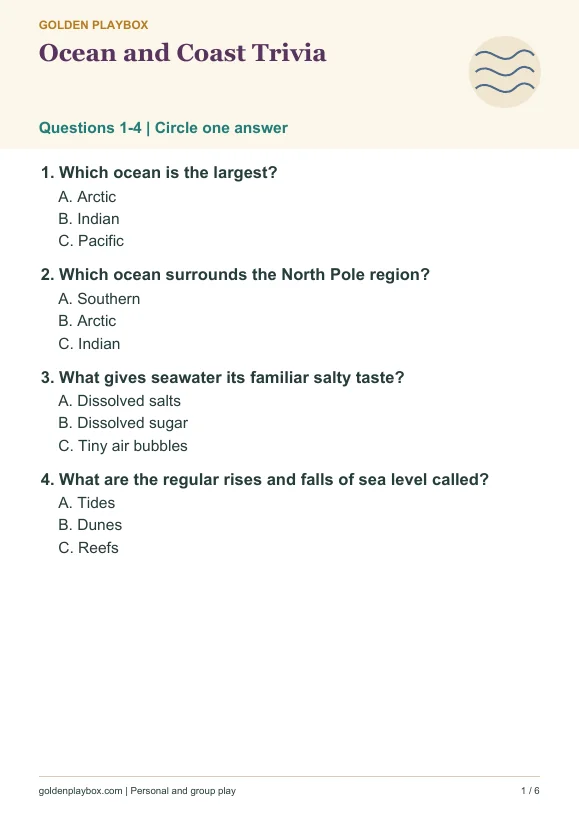
Which ocean is the largest? Pacific. The Pacific is the largest ocean basin. Naming ocean basins helps describe a connected global ocean rather than separate bodies sealed off from one another.
Which ocean surrounds the North Pole region? Arctic. The Arctic Ocean lies around the North Pole. Antarctica is at the opposite end of the planet, surrounded by the Southern Ocean.
What gives seawater its familiar salty taste? Dissolved salts. Seawater contains dissolved salts. Rivers, rocks and geological processes contribute materials to the ocean over time; the salt is not produced by waves.
What are the regular rises and falls of sea level called? Tides. Tides are recurring changes in sea level, strongly influenced by the Moon and Sun. Wind-driven waves are a different kind of water movement.
Are coral polyps animals or plants? Animals. Coral polyps are animals. Reef-building corals often live with algae, which can make the animal-and-plant relationship more interesting than the first answer suggests.
Which marine mammal breathes air through lungs? Dolphin. A dolphin is a mammal and breathes air. It must reach the surface, unlike fish that obtain oxygen from water using gills.
What is an estuary? Where river water mixes with seawater. An estuary is a coastal meeting place for fresh and salt water. Such areas vary with tides and river flow rather than having one fixed salinity.
What is the collective term for aquatic organisms that drift with currents? Plankton. Plankton include many kinds of drifting organisms. The term describes their relationship to currents rather than naming one single species of plant or animal.
What is a mangrove best described as? A salt-tolerant coastal tree or shrub. Mangroves grow in coastal settings and tolerate salty conditions. Their roots create habitat and help distinguish these forests from ordinary inland woodland.
What causes most ordinary surface ocean waves? Wind. Wind transfers energy to the surface and produces many familiar waves. Tsunamis have different causes, so the wording deliberately specifies ordinary surface waves.
Which marine animal has eight arms? Octopus. An octopus has eight arms. This familiar feature makes a useful contrast with other marine animals without asking participants to remember a scientific species name.
What is a lighthouse traditionally used for? Helping navigation near coasts. A lighthouse provides a navigational signal. Different lights and patterns help mariners recognize locations; a lighthouse does not control the surrounding sea.
Print and play
Choose A4 or US Letter, print at 100%, and keep any answers or calling list with the host. Free for personal and group activities. Printing help and hosting tips.
References for this game
More games to try
- The 1960s Quiz — Ten multiple-choice questions about familiar music, television and milestones of the 1960s.
- Working Life Cards — Working life includes paid jobs, unpaid responsibilities, informal help, and skills learned along the way.
- Neighborhood Stories Cards — Neighborhoods are made from ordinary details: a useful shop, a familiar corner, a place to pause, and the people who make a space welcoming.