 Golden Playbox
Prepared by Golden Playbox · Published November 13, 2026
How to play
- Print pages 1-3 for each player or pair. Keep pages 4-6 with the host.
- Circle one answer for each question. Read the choices aloud if helpful.
- Award one point per correct answer out of twelve, or play without scores.
About this printable round
This printable geography round follows rivers through familiar cities and introduces a few well-known lakes. Twelve multiple-choice questions emphasize recognizable connections instead of disputed length rankings or changing water measurements. The answer guide supplies context for each location, allowing a host to pause for conversation. It can be played from memory, or as a cooperative map activity if that is agreed beforehand. No travel experience or specialist map-reading skill is required.
Host the conversation
Explain whether the group should answer from memory or consult a map; avoid changing that rule halfway through a scored round. Rivers cross boundaries, so accept a discussion that goes beyond one country even when the question names a single city. A useful extension is to imagine sending a postcard from a riverbank and describe the type of scene it might show, keeping inventions separate from the facts. Do not use the quiz as a swimming or boating guide. Real water conditions, permissions and access require current local information and are outside this relaxed paper activity.
Questions, answers and talking points
The following walkthrough contains spoilers. Keep this section with the host if participants want to answer the printable questions first.
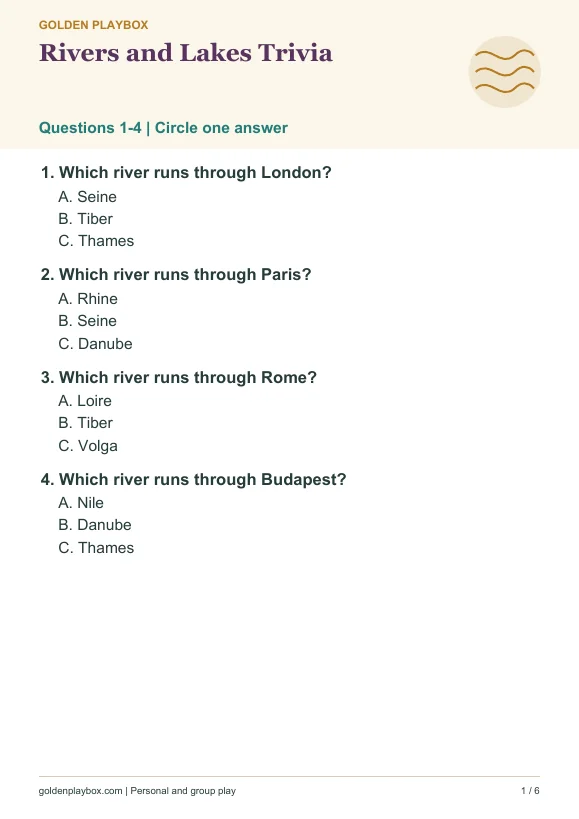
Which river runs through London? Thames. The Thames runs through London. It links many familiar city views, making the answer accessible through photographs and stories as well as personal travel.
Which river runs through Paris? Seine. The Seine runs through Paris. Its relationship to the city is the key clue, rather than its total length or the number of bridges across it.
Which river runs through Rome? Tiber. The Tiber runs through Rome. Matching a river to a city creates a manageable geographical connection without asking participants to trace the entire drainage basin.
Which river runs through Budapest? Danube. The Danube runs through Budapest and many other European places. The question names one recognizable city rather than suggesting that the river belongs to a single country.
Which major river is closely associated with Egypt? Nile. The Nile is closely associated with Egypt and also flows through or draws water from other countries. Avoid reducing a multinational river system to only one place.
Which great river flows through the Amazon rainforest? Amazon. The Amazon flows through the rainforest region that shares its name. Its tributaries form a large river system, which is different from considering only the main channel.
Which river is associated with the Grand Canyon? Colorado. The Colorado River runs through the Grand Canyon. This link connects the river round with a national parks theme without requiring knowledge of present flow management.
Which river runs through Washington, D.C.? Potomac. The Potomac borders and runs alongside Washington, D.C. The city-river association is a broad geographical clue rather than a question about exact municipal boundaries.
Which lake is one of North America's Great Lakes? Lake Superior. Lake Superior is one of the Great Lakes. The alternatives are real lakes elsewhere, making the task one of regional recognition rather than invented-name elimination.
Lake Titicaca lies between Peru and which other country? Bolivia. Lake Titicaca is shared by Peru and Bolivia. The question highlights a cross-border lake, complementing the round's examples of rivers that connect multiple places.
Which lake is well known in northern Italy? Lake Como. Lake Como is in northern Italy. Its familiar name offers a European lake example without asking participants to recall tourist towns or current travel arrangements.
Which Russian lake is famous for being the world's deepest freshwater lake? Lake Baikal. Lake Baikal is the deepest freshwater lake. Depth is the specific distinction here; largest surface area and greatest volume are separate comparisons with different meanings.
Print and play
Choose A4 or US Letter, print at 100%, and keep any answers or calling list with the host. Free for personal and group activities. Printing help and hosting tips.
References for this game
More games to try
- The 1960s Quiz — Ten multiple-choice questions about familiar music, television and milestones of the 1960s.
- Working Life Cards — Working life includes paid jobs, unpaid responsibilities, informal help, and skills learned along the way.
- Neighborhood Stories Cards — Neighborhoods are made from ordinary details: a useful shop, a familiar corner, a place to pause, and the people who make a space welcoming.