 Golden Playbox
Prepared by Golden Playbox · Published November 13, 2026
How to play
- Print pages 1-3 for each player or pair. Keep pages 4-6 with the host.
- Circle one answer for each question. Read the choices aloud if helpful.
- Award one point per correct answer out of twelve, or play without scores.
About this printable round
Settle into a café-style round about two familiar drinks. This printable tea and coffee quiz covers plants, preparation words and everyday equipment, with twelve questions and a separate answer key. It does not ask participants to recognize expensive varieties or perform a taste test. The multiple-choice format leaves room for discussion about habits and regional names. A person who prefers neither drink can still participate through the plant and utensil clues.
Host the conversation
Start by asking which cup or mug someone would choose for an imaginary café, rather than asking about caffeine intake. Drinks are optional props, and there is no need to serve anything hot. During the tea questions, explain the difference between tea from the tea plant and herbal infusions, while acknowledging ordinary menu language. A gentle extension is to plan a café sign with three drink names from the quiz. Keep personal preferences separate from correct answers: whether milk goes in first, or which drink tastes best, is not scored in this round.
Questions, answers and talking points
The following walkthrough contains spoilers. Keep this section with the host if participants want to answer the printable questions first.
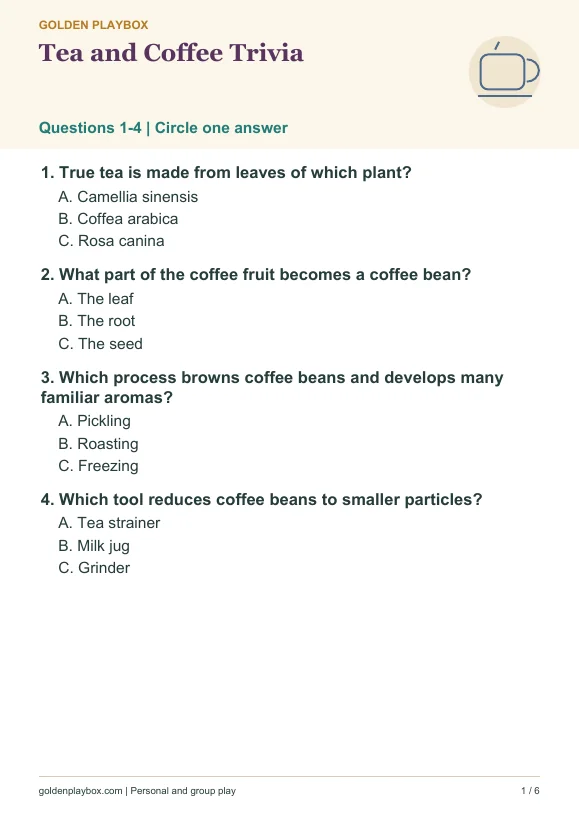
True tea is made from leaves of which plant? Camellia sinensis. Black, green and several other teas come from Camellia sinensis. Different processing methods help produce their differences; they are not necessarily separate plant species.
What part of the coffee fruit becomes a coffee bean? The seed. A coffee bean is a seed from the coffee fruit. The familiar kitchen name does not mean it is the same kind of bean as a legume.
Which process browns coffee beans and develops many familiar aromas? Roasting. Roasting transforms green coffee beans through heat. Grinding changes particle size afterward, so the two steps have distinct purposes in preparing the drink.
Which tool reduces coffee beans to smaller particles? Grinder. A grinder breaks beans into smaller particles. The chosen grind affects brewing, but the quiz does not require anyone to remember equipment-specific settings.
Which drink is made by forcing hot water through finely ground coffee under pressure? Espresso. Espresso is a brewing method using pressure. It is not the name of one unique coffee bean species or simply a synonym for every small coffee.
Which coffee drink traditionally combines espresso, steamed milk and foam? Cappuccino. Cappuccino combines espresso with milk and foam. Café recipes and serving sizes vary, so the question focuses on the basic combination rather than fixed proportions.
Which drink is commonly made by adding hot water to espresso? Americano. An Americano combines espresso and hot water. The order and proportions can vary, but milk is not required to define this coffee preparation.
Which item catches loose tea leaves when pouring? Tea strainer. A tea strainer holds back loose leaves. Infusers can hold leaves during brewing, offering a useful comparison between two familiar pieces of tea equipment.
What is the usual term for leaving tea leaves in hot water? Steeping. Steeping allows soluble compounds to move into the water. Time and temperature affect the result, but those preferences are not treated as quiz answers.
Which of these is a herbal infusion rather than tea from Camellia sinensis? Peppermint infusion. Peppermint infusion comes from mint rather than the tea plant. Everyday speech often calls it herbal tea, which is perfectly understandable outside botanical classification.
Which vessel is traditionally used to brew and pour several cups of tea? Teapot. A teapot is designed for brewing and serving tea. Its size and material vary widely, leaving room for memories without implying one correct household tradition.
Which word describes coffee with much of its caffeine removed? Decaffeinated. Decaffeinated coffee has had much of its caffeine removed. The term does not necessarily mean absolutely no caffeine, so the wording avoids that common overstatement.
Print and play
Choose A4 or US Letter, print at 100%, and keep any answers or calling list with the host. Free for personal and group activities. Printing help and hosting tips.
References for this game
More games to try
- The 1960s Quiz — Ten multiple-choice questions about familiar music, television and milestones of the 1960s.
- Working Life Cards — Working life includes paid jobs, unpaid responsibilities, informal help, and skills learned along the way.
- Neighborhood Stories Cards — Neighborhoods are made from ordinary details: a useful shop, a familiar corner, a place to pause, and the people who make a space welcoming.