 Golden Playbox
Prepared by Golden Playbox · Published November 13, 2026
How to play
- Print pages 1-3 for each player or pair. Keep pages 4-6 with the host.
- Circle one answer for each question. Read the choices aloud if helpful.
- Award one point per correct answer out of twelve, or play without scores.
About this printable round
A woodland theme can begin with everyday objects: an acorn, a leaf, a piece of paper or a wooden chair. This twelve-question tree quiz uses common tree vocabulary and familiar examples rather than microscopic identification. It is designed for a relaxed group that may include keen gardeners and people who simply enjoy a shady path. The printed choices support discussion, and the answer notes explain the distinction behind each question without assuming botanical training.
Host the conversation
If you bring leaves or cones to the table, use only clean, safely collected examples and keep them optional. The printable does not require handling, tasting or smelling anything. Ask participants to describe shape and texture before trying a species name. A useful follow-up is to compare the words evergreen and conifer: they often overlap, but they are not interchangeable definitions. Keep local variation in mind when discussing seasonal leaf loss. For a short creative ending, invite each person to name a tree they would include in an imaginary public garden and explain the choice.
Questions, answers and talking points
The following walkthrough contains spoilers. Keep this section with the host if participants want to answer the printable questions first.
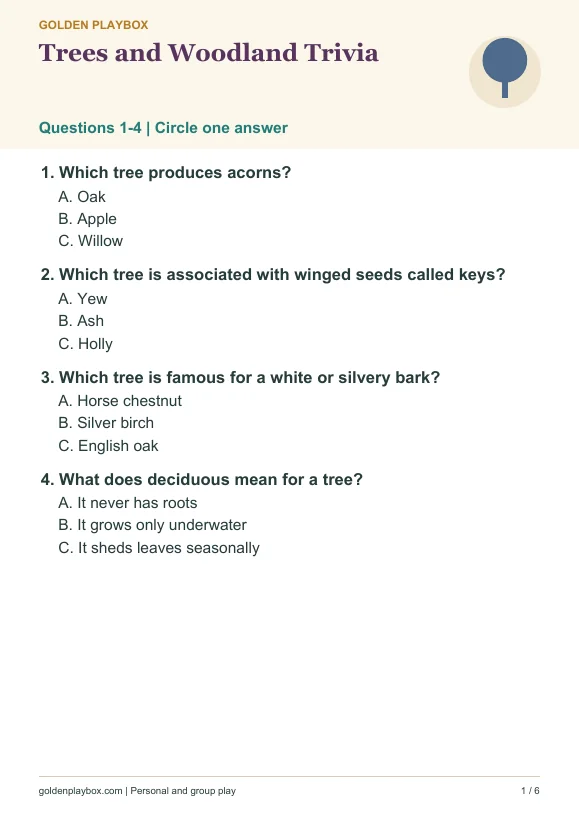
Which tree produces acorns? Oak. Acorns are the fruits of oak trees. This familiar association provides an accessible starting point before the quiz introduces more general botanical terms.
Which tree is associated with winged seeds called keys? Ash. Ash trees produce winged fruits often called keys. Several other trees also have winged seeds, so the named options are important to the question.
Which tree is famous for a white or silvery bark? Silver birch. Silver birch is recognizable for its pale bark. Bark can help identify a tree when leaves are absent, although age and growing conditions affect appearance.
What does deciduous mean for a tree? It sheds leaves seasonally. Deciduous trees shed their leaves during a particular season. The timing depends on climate and species, so autumn is not a universal global rule.
What does evergreen mean? It keeps foliage through the year. Evergreen trees retain foliage year-round while replacing individual leaves. The word describes the overall appearance, not the permanent survival of every leaf.
Which part anchors a tree and absorbs water? Roots. Roots anchor the tree and take up water and minerals. They also have other roles, so this is a functional introduction rather than a complete description.
Which green pigment helps leaves capture light? Chlorophyll. Chlorophyll is involved in photosynthesis and gives many leaves their green appearance. Seasonal changes reveal that leaves contain more than one kind of pigment.
What process lets green plants use light to make sugars? Photosynthesis. Photosynthesis uses light energy to make sugars from carbon dioxide and water. It is different from simply absorbing ready-made food through the roots.
Which tree produces conkers? Horse chestnut. Conkers are the seeds of horse chestnut. They are not the same as edible sweet chestnuts, so the game should never become a tasting activity.
Which tree often has prickly leaves and red berries? Holly. Holly commonly has glossy, prickly leaves and red berries on female plants. Not every holly leaf or plant shows both features, which is worth acknowledging.
Which conifer commonly loses its needles in autumn? Larch. Larch is a deciduous conifer. It provides a useful exception to the assumption that every needle-bearing tree must remain green throughout the winter.
What can annual growth rings help estimate? A tree's age. Annual rings can help estimate age and reveal growth history. Reading them is more nuanced than assuming every visible mark always represents one simple year.
Print and play
Choose A4 or US Letter, print at 100%, and keep any answers or calling list with the host. Free for personal and group activities. Printing help and hosting tips.
References for this game
More games to try
- The 1960s Quiz — Ten multiple-choice questions about familiar music, television and milestones of the 1960s.
- Working Life Cards — Working life includes paid jobs, unpaid responsibilities, informal help, and skills learned along the way.
- Neighborhood Stories Cards — Neighborhoods are made from ordinary details: a useful shop, a familiar corner, a place to pause, and the people who make a space welcoming.