 Golden Playbox
Prepared by Golden Playbox · Published November 13, 2026
How to play
- Print pages 1-3 for each player or pair. Keep pages 4-6 with the host.
- Circle one answer for each question. Read the choices aloud if helpful.
- Award one point per correct answer out of twelve, or play without scores.
About this printable round
Weather gives a table an immediate shared subject: everyone has looked out of a window and changed a plan. This printable round covers familiar instruments, clouds and forms of water without asking anyone to interpret a technical forecast chart. The twelve questions are designed for a leisurely conversation about everyday observations. Some choices are deliberately contrasting, allowing participants to reason aloud. The answer notes clarify terms that often get used loosely in ordinary conversation.
Host the conversation
Open with a neutral observation about today's sky rather than a question about a frightening storm. Invite people to describe a cloud using ordinary words before introducing a scientific name. If someone recalls a severe weather event, let them decide whether to continue that story; a quiz does not need dramatic personal accounts. To extend the activity, compare the words drizzle, shower and downpour and discuss what clothing each suggests. Forecasts change, so use the quiz for general knowledge and consult current local guidance for any real outdoor plans.
Questions, answers and talking points
The following walkthrough contains spoilers. Keep this section with the host if participants want to answer the printable questions first.
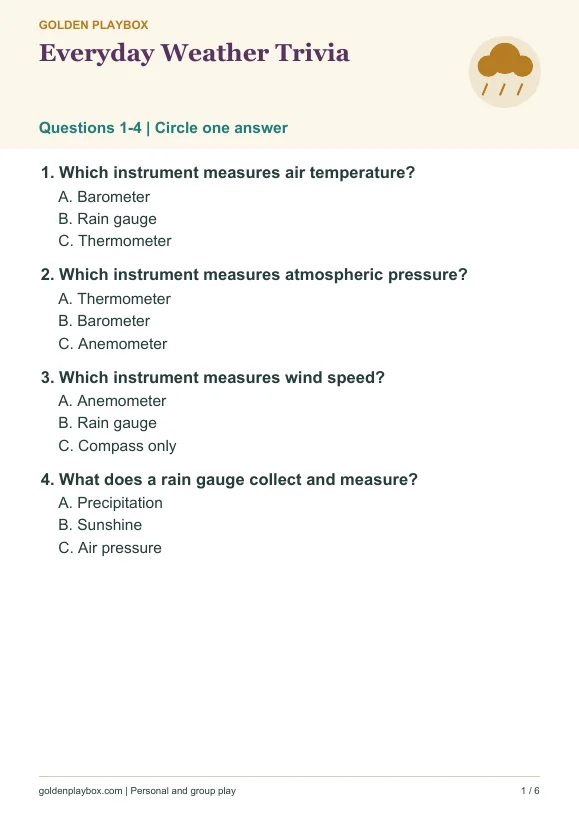
Which instrument measures air temperature? Thermometer. A thermometer measures temperature. Keeping temperature separate from pressure and rainfall makes the other instrument questions easier to approach by elimination.
Which instrument measures atmospheric pressure? Barometer. A barometer measures air pressure. Pressure patterns help forecasters understand weather systems, but one reading alone does not describe the whole forecast.
Which instrument measures wind speed? Anemometer. An anemometer measures wind speed. A wind vane indicates direction, so the two instruments answer different questions about the same moving air.
What does a rain gauge collect and measure? Precipitation. A rain gauge measures collected precipitation. Its reading is expressed as a depth over an area, not as the total water in an entire storm.
What is fog, in simple terms? A cloud at ground level. Fog consists of tiny water droplets or ice crystals near the ground. It is related to clouds rather than being another name for ordinary smoke.
What is water vapor changing into liquid droplets called? Condensation. Condensation changes water vapor into liquid. The droplets on a cool surface are a familiar example that can help explain cloud formation.
What is liquid water changing into water vapor called? Evaporation. Evaporation changes liquid water to vapor. It can occur without water reaching its boiling point, as a drying puddle shows on an ordinary day.
What produces the sound of thunder? Rapid expansion of air heated by lightning. Lightning heats air very rapidly, and the resulting expansion produces thunder. The old image of clouds colliding is memorable but not the physical explanation.
Which type of cloud is often tall and associated with thunderstorms? Cumulonimbus. Cumulonimbus clouds develop vertically and can bring thunderstorms. Their tall structure distinguishes them from a thin veil of high cloud or a low fog bank.
Which word describes frozen balls or lumps of precipitation? Hail. Hail consists of ice formed within storm clouds. It differs from dew, which forms on surfaces, and mist, which consists of tiny suspended droplets.
What is a wind vane mainly used to show? Wind direction. A wind vane shows the direction from which the wind blows. Weather descriptions generally name a wind for where it comes from.
Which term describes weather patterns over many years? Climate. Climate describes long-term patterns and statistics. Weather describes conditions over shorter periods, so a single cold afternoon does not define an area's climate.
Print and play
Choose A4 or US Letter, print at 100%, and keep any answers or calling list with the host. Free for personal and group activities. Printing help and hosting tips.
References for this game
More games to try
- The 1960s Quiz — Ten multiple-choice questions about familiar music, television and milestones of the 1960s.
- Working Life Cards — Working life includes paid jobs, unpaid responsibilities, informal help, and skills learned along the way.
- Neighborhood Stories Cards — Neighborhoods are made from ordinary details: a useful shop, a familiar corner, a place to pause, and the people who make a space welcoming.