 Golden Playbox
Prepared by Golden Playbox · Published November 13, 2026
How to play
- Print pages 1-3 for each player or pair. Keep pages 4-6 with the host.
- Circle one answer for each question. Read the choices aloud if helpful.
- Award one point per correct answer out of twelve, or play without scores.
About this printable round
Take an imaginary gallery visit with a quiz about artists, materials and familiar kinds of pictures. These twelve questions mix recognizable names with everyday art vocabulary, so the activity does not depend on recognizing a tiny reproduction. The printed choices allow discussion among people with different interests. A separate answer key explains the terms and identifies the artists. The round is intended as a welcoming conversation about looking at art, not a test of whether someone knows the correct personal opinion.
Host the conversation
Ask which kind of picture participants might place in an imaginary room: a landscape, portrait or still life. All preferences are valid and remain unscored. During the answer discussion, distinguish an artist's name from a style or material. If real artworks are shown afterward, use museum collections with appropriate image permissions and describe what is visible before naming a movement. A useful extension is to invent a gallery label for an everyday object, noting its material and shape. Keep that creative exercise separate from the factual questions so imagination is not mistaken for a historical claim.
Questions, answers and talking points
The following walkthrough contains spoilers. Keep this section with the host if participants want to answer the printable questions first.
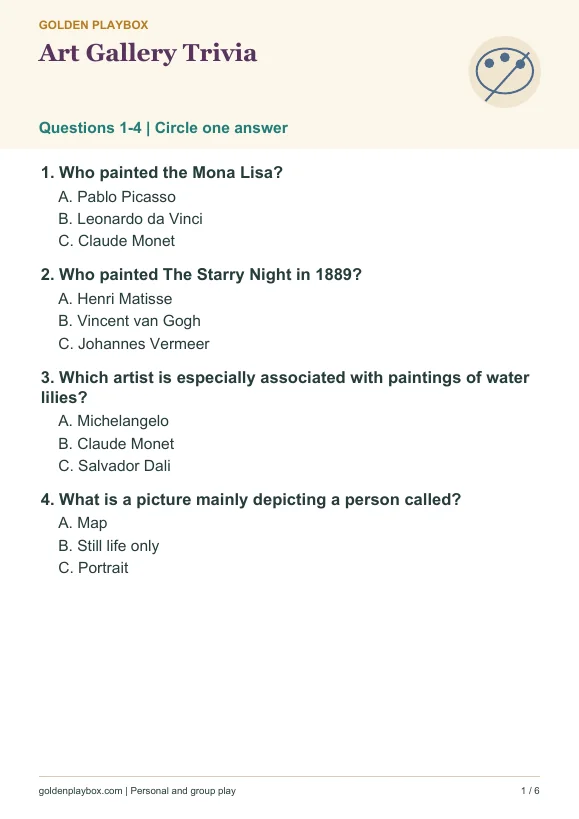
Who painted the Mona Lisa? Leonardo da Vinci. Leonardo da Vinci painted the Mona Lisa. The question uses a widely recognizable work rather than requiring detailed knowledge of its ownership or exhibition history.
Who painted The Starry Night in 1889? Vincent van Gogh. Vincent van Gogh painted The Starry Night. Specifying the year and familiar title avoids confusing it with other night-sky paintings and similarly named works.
Which artist is especially associated with paintings of water lilies? Claude Monet. Claude Monet repeatedly painted water lilies. A recurring subject can connect different works across an artist's career without making each painting an identical image.
What is a picture mainly depicting a person called? Portrait. A portrait represents a person or people. It can communicate character and social context as well as appearance, leaving room for discussion after the definition.
What is a picture mainly depicting countryside or natural scenery called? Landscape. A landscape focuses on scenery. The term describes subject matter rather than one particular medium, period or degree of realistic detail in the work.
What is an arrangement of objects such as fruit and flowers in a painting called? Still life. A still life depicts arranged objects. Ordinary items can carry visual or symbolic interest, which makes this a useful connection to objects already on the table.
Which material is traditionally shaped and fired to make pottery? Clay. Clay is shaped and fired to make pottery. Firing changes the material, distinguishing finished ceramic objects from a temporary shape made in soft modeling clay.
Which art form creates three-dimensional objects? Sculpture. Sculpture works in three dimensions. It can use many materials and methods, so carving stone is one example rather than the only possible technique.
Which artist created the famous marble David in Florence? Michelangelo. Michelangelo created the famous marble David in Florence. The identifying details matter because other artists also made works representing the same biblical figure.
What is a painting made on fresh wet plaster called? Fresco. A fresco is painted onto wet plaster. The surface and process distinguish it from simply applying any kind of paint to a dry wall.
What is an artwork assembled from attached pieces of paper or other materials called? Collage. A collage combines attached materials into an image or composition. It offers a familiar example of art made through arrangement rather than drawing alone.
Which tool commonly holds a painter's canvas upright? Easel. An easel supports a canvas or panel during work or display. It is equipment rather than part of the painted image, making a practical closing question.
Print and play
Choose A4 or US Letter, print at 100%, and keep any answers or calling list with the host. Free for personal and group activities. Printing help and hosting tips.
References for this game
More games to try
- The 1960s Quiz — Ten multiple-choice questions about familiar music, television and milestones of the 1960s.
- Working Life Cards — Working life includes paid jobs, unpaid responsibilities, informal help, and skills learned along the way.
- Neighborhood Stories Cards — Neighborhoods are made from ordinary details: a useful shop, a familiar corner, a place to pause, and the people who make a space welcoming.